


5 June 2026 · 9 min read · Ed
The Best Salt-Tolerant Plants for Brighton & Sussex Coastal Gardens

Gardening within sight of the sea is a particular kind of privilege — and a particular kind of problem. The light is extraordinary, the views are hard to beat, and the climate is mild. But the salt-laden wind that rolls in off the Channel will quietly shred anything that isn't built for it. If you've watched a beautiful shrub crisp and brown on its seaward side within a season, you already know: choosing the right coastal garden plants is the difference between a garden that fights the conditions and one that revels in them.
This guide is written for gardens in Brighton, Hove and across the Sussex coast — from exposed seafront terraces to the chalky, wind-blasted slopes of the South Downs. We'll cover why coastal gardens are hard, how to shelter them properly, and — the part everyone wants — the salt-tolerant plants that genuinely thrive here, with a few to avoid.
Why coastal gardens in Brighton & Hove are a special challenge
Three things make a seaside garden behave differently from an inland one, and a good garden design has to answer all three.
1. Salt spray. Onshore wind carries fine droplets of seawater inland, sometimes for a mile or more. Salt draws moisture out of soft leaves and scorches new growth. The plants that cope are often halophytes — species adapted to salty conditions — or have physical defences: waxy coatings, silvery hairs, small or leathery leaves that simply give the salt less to grab onto.
2. Wind. It's relentless, and it's the single biggest factor. Constant wind desiccates foliage, rocks root systems loose, and turns tender plants to mush. The Royal Horticultural Society is blunt about it: as their guide to coastal gardens notes, strong, often salt-laden winds present the main challenge — and how you handle the wind matters more than almost any plant choice.
3. Free-draining soil. Much of Brighton and the Downs sits on chalk and thin, sandy or stony soil that drains in minutes. Combined with sun and wind, that means drought stress is common — which, helpfully, points us straight at tough, drought-tolerant planting that also happens to suit the current move away from thirsty bedding.
The upshot: a coastal Sussex garden wants plants that shrug off salt, bend in the wind rather than snapping, and don't sulk in lean, fast-draining ground. There are more of them than you'd think.
Start with shelter, not plants: windbreaks that actually work
Here's the mistake almost everyone makes: they build a solid wall or close-boarded fence to block the wind. It feels logical. It's wrong.
A solid barrier doesn't stop wind — it forces it up and over, creating damaging turbulence and downdraughts on the other side that can be worse than no barrier at all. The RHS recommendation is to filter the wind instead: a permeable screen that lets roughly half the wind through slows it gently without the turbulence. Think slatted timber, woven willow or hazel hurdles, or — best of all — living windbreaks of tough trees and shrubs.
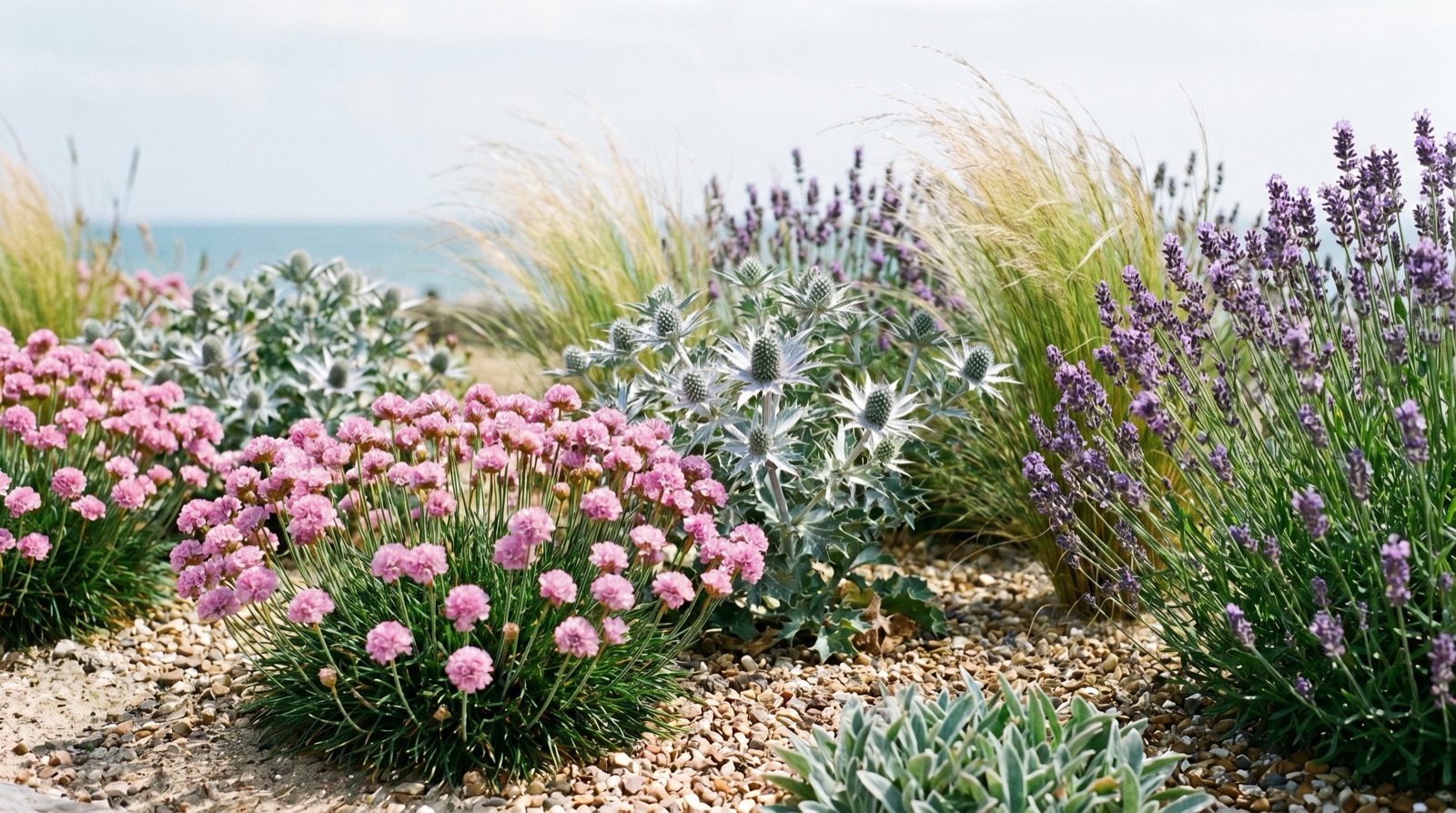 With shelter in place, salt-tolerant planting thrives — pink sea thrift, blue sea holly, ornamental grasses and lavender in a free-draining coastal border.
In practice, a sheltered coastal garden usually layers two or three defences:
- An outer living windbreak — salt-hardy shrubs or hedging that take the brunt (more on these below).
- Permeable screens or fencing where space is tight — slatted panels or hurdles that filter rather than block.
- Internal structure — hedges and planting that create calmer micro-climates closer to the house, where you can then grow slightly less bombproof things.
Get the shelter right and your plant palette suddenly widens. Skip it, and even tough plants struggle. This is exactly the kind of thing we resolve on paper first, using 3D visuals so you can see the layout before anything is built.
The best salt-tolerant plants for Sussex coastal gardens
With shelter in place, here's a palette that earns its keep on the Sussex coast. Many are British natives or naturalised seaside survivors — plants that have lived on clifftops and shingle for millennia.
| Plant | Type | Why it thrives by the sea |
|---|---|---|
| Sea thrift (Armeria maritima) | Perennial | A UK native of clifftops and shingle; laughs at salt, wind and poor soil |
| Sea holly (Eryngium) | Perennial | Architectural, spiny, silver-blue; loves sun and sharp drainage |
| Griselinia littoralis | Evergreen hedge | One of the best coastal hedges — glossy, salt-resistant leaves |
| Escallonia | Evergreen shrub | Classic seaside hedging with summer flower; takes wind well |
| Hebe | Evergreen shrub | Compact, salt-tolerant, long flowering season |
| Lavender (Lavandula) | Sub-shrub | Mediterranean toughness; sun, drought and free-draining soil |
| Crocosmia | Perennial | Vivid, vigorous, naturalises happily near the coast |
| Red valerian (Centranthus ruber) | Perennial | Self-seeds into walls and lean soil — you'll see it all over Brighton |
| Festuca glauca | Grass | Blue, drought- and salt-tolerant; movement and texture |
| Sedum / Hylotelephium | Succulent perennial | Stores water in fleshy leaves; shrugs off drought and wind |
Structural shrubs & hedging
Your first line of defence — and the bones of the garden in winter. Griselinia littoralis is arguably the finest evergreen coastal hedge for Sussex: fresh apple-green leaves, dense, and genuinely salt-proof. Escallonia, Euonymus, Pittosporum, Elaeagnus and the silver-leaved Tamarisk all make excellent wind-filtering screens, while compact Hebe and Olearia (the daisy bush) work as lower structure further in.
Flowering perennials for colour
This is where a coastal garden comes alive in summer. Sea thrift cushions the front of a border in pink; sea holly brings metallic, sculptural structure; and red valerian self-seeds into the poorest pockets. Add lavender, agapanthus, eryngium, erigeron (Mexican fleabane, which colonises walls and paving cracks) and bold drifts of crocosmia for late-summer fire.
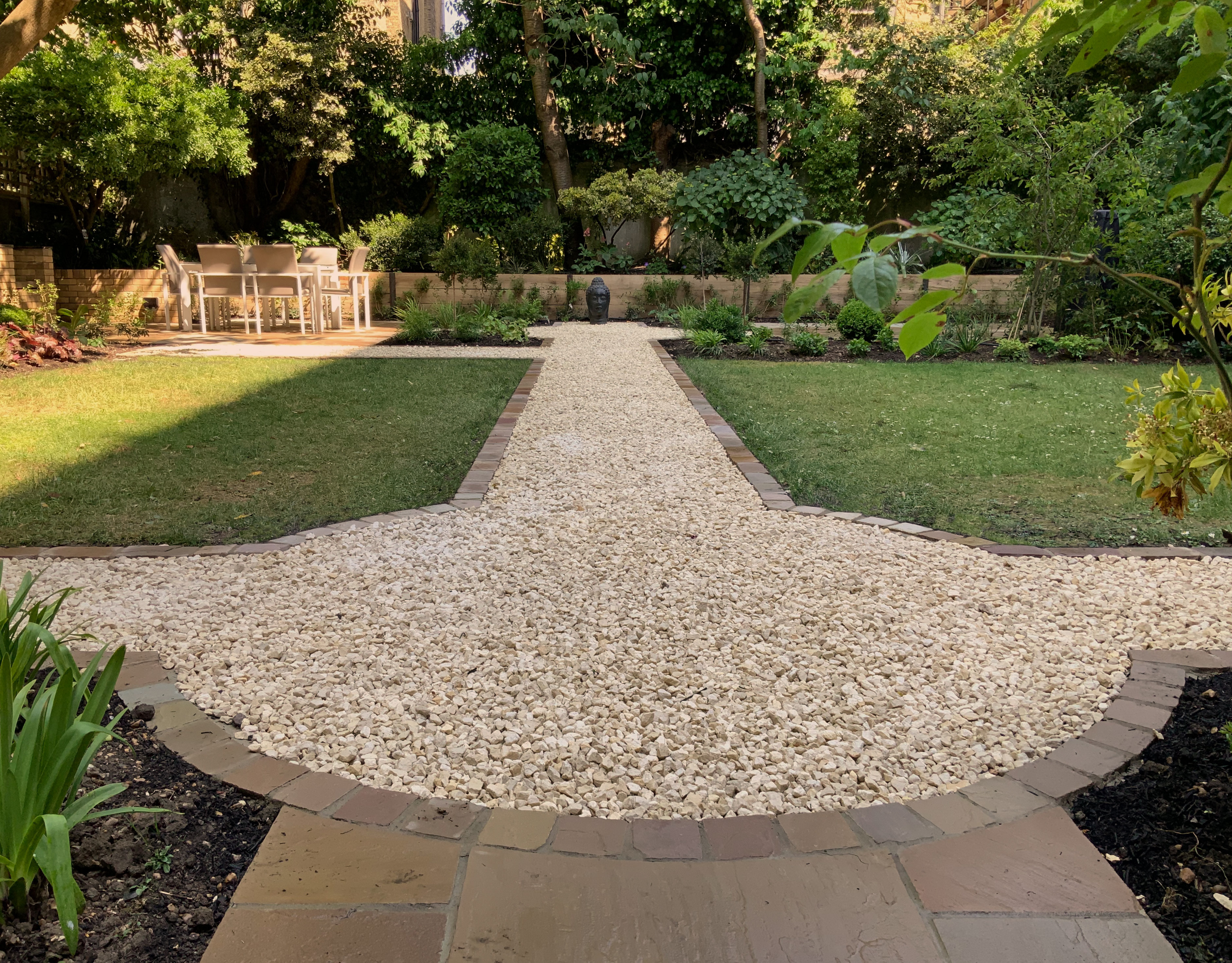 Sun-loving, drought-tolerant planting in a Hove garden — the same palette that copes with coastal conditions. See the Grand Avenue project →
Grasses & movement
Grasses are the secret weapon of coastal planting — they use the wind instead of fighting it, catching the light and moving all day. Festuca glauca (blue and tidy), Stipa tenuissima (soft and feathery), Calamagrostis (upright and architectural) and the larger Miscanthus all thrive in sun and sharp drainage.
Ground cover & erosion control
On slopes and exposed ground, low spreading plants knit the soil together and reduce erosion. Sedum and Hylotelephium, creeping thyme, Cerastium (snow-in-summer) and thrift all carpet poor ground, hold it in place and need almost no attention.
Plants to avoid near the seafront
Some plants will always struggle in the front line, however much you love them. Large, soft or thin leaves are the giveaway — they're salt magnets. Be cautious, in exposed positions, with Japanese maples (Acer palmatum), hostas, big-leaved hydrangeas, ferns and most tender, moisture-loving exotics. They can absolutely work — but only in the sheltered, calmer pockets you've created closer to the house, never on the windward edge.
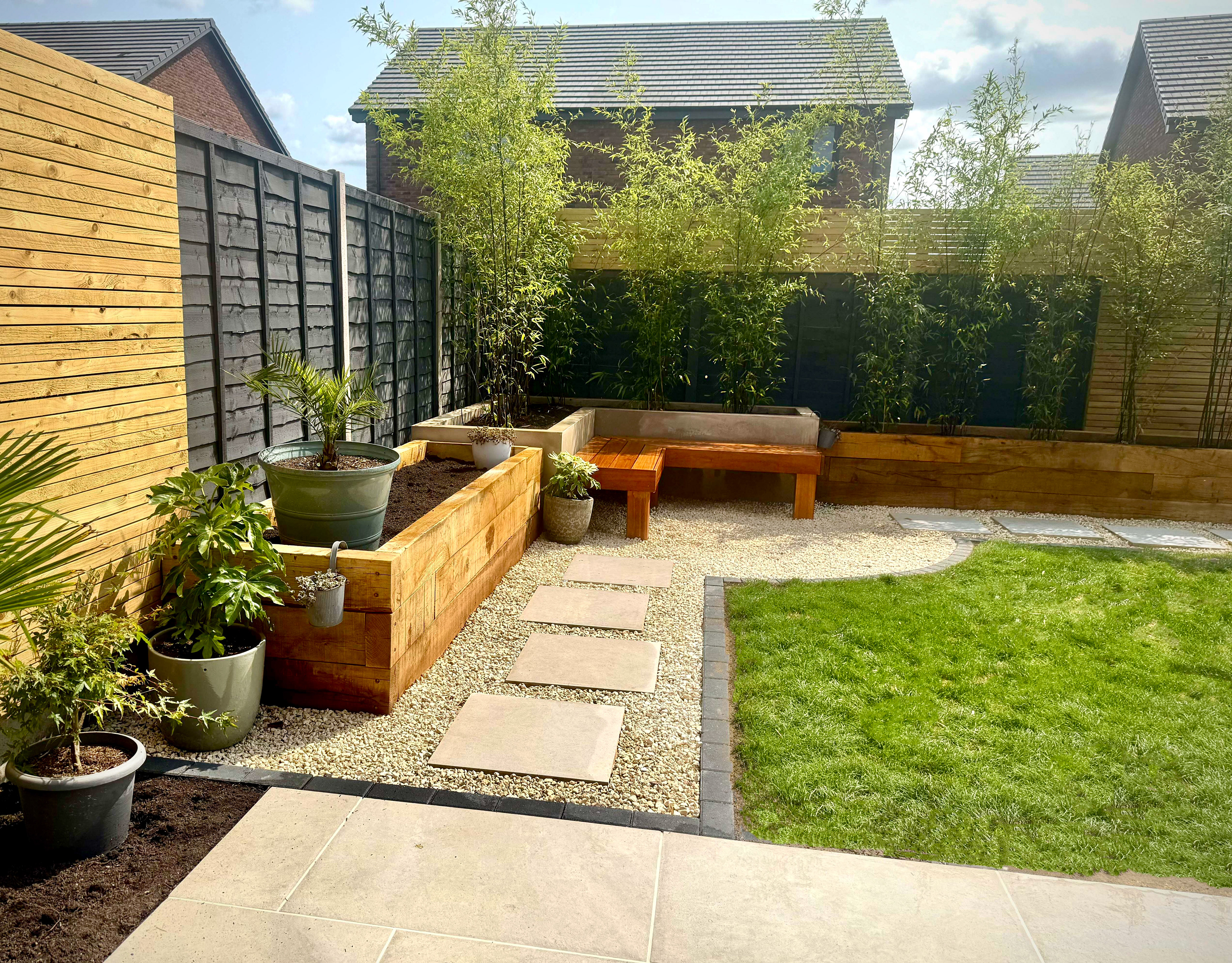 Evergreen structure — box, pittosporum and phormium — carries a garden through winter, when perennials have died back. See the Abi & Tom project →
Designing for year-round interest, not just summer
A coastal garden shouldn't only look good in July. Because so much salt-tolerant planting is evergreen — griselinia, pittosporum, hebe, olearia — the coast actually lends itself beautifully to year-round structure. The trick is to layer it: an evergreen backbone for winter, perennials and grasses for the long summer show, and a few seasonal highlights to mark the turning of the year.
It's also worth knowing that salt-tolerant and drought-tolerant plant lists overlap enormously. Choosing this palette doesn't just survive the coast — it gives you a low-maintenance, low-water garden that's exactly where UK gardening is heading. (If you're weighing up a full redesign, our guide to what garden design costs in Brighton & Hove is a useful next read.)
Coastal-tolerant planting in practice: a Hove garden
A good example is a garden we designed and built on St Heliers Avenue in Hove. It leans on exactly the palette this guide recommends — agapanthus, lavender, phormium and ornamental grasses — plants that shrug off sun, wind and free-draining soil and still look sharp. Set within a strong, considered layout, that resilient planting does the heavy lifting: low-fuss, sea-air-tolerant, and good across the seasons. Structure first, then the right plants — that's the whole game near the coast.
Frequently asked questions
What are the best plants for a coastal garden in the UK? Tough, salt-tolerant species: sea thrift, sea holly, lavender, hebe, escallonia, griselinia, crocosmia, red valerian and ornamental grasses like festuca and stipa. Most cope with salt, wind and free-draining soil — exactly the conditions a Brighton or Sussex seafront garden throws at them.
Which plants survive salt spray? Plants with waxy, silvery, small or leathery leaves cope best — many are coastal natives or halophytes. Griselinia, pittosporum, escallonia, sea holly and thrift are all reliably salt-resistant.
How do I protect my garden from sea wind? Filter the wind rather than blocking it. A permeable windbreak — slatted fencing, woven hurdles, or a living hedge of salt-hardy shrubs — slows the wind without the damaging turbulence a solid wall or fence creates. The RHS coastal gardening guide explains why.
Can I grow a lawn in a coastal Brighton garden? Yes, though on thin chalky or sandy soil a hard-wearing, drought-tolerant grass mix is wise, and it may brown in summer droughts. Many coastal gardens look better with gravel, planting and paving doing more of the work than a thirsty lawn.
What soil do coastal Brighton gardens have? Often chalky, sandy or stony and very free-draining — which suits Mediterranean and coastal planting well. Adding organic matter helps retain a little moisture, but it's usually easier (and more in keeping) to choose plants that love sharp drainage than to fight the soil.
Thinking about a coastal or low-maintenance garden of your own? Every project starts with a conversation on site, where we look at your aspect, your exposure and your soil before a single plant is chosen. Get in touch and we'll talk it through.
Thinking about your own garden?
Every project begins with a conversation. Tell us about your space and we’ll talk through what’s possible.
Get in touch